Photonic Quantum Computing

Quantum computers,
made of light.

I'm Minsuk Jun, a senior in Electrical & Electronic Engineering at Sungkyunkwan University, researching continuous-variable photonic quantum computing at Seoul National University.

Q-SPIN Lab, Seoul National University Sungkyunkwan University Seoul, Korea

Drag the chip to rotate

Research

Selected figures

01Squeezed vacuumsqueezer 02Cat stateafter photon subtraction 03Bred catafter the breeder 04GKP-likenext breeding round Squeezerpropagation loss Edge couplertaper loss Beam splitterexcess loss SNSPDdetection efficiency BHDhomodyne efficiency Two cat states After the 50:50 BS Balanced homodyne · p = 0 Heralded output
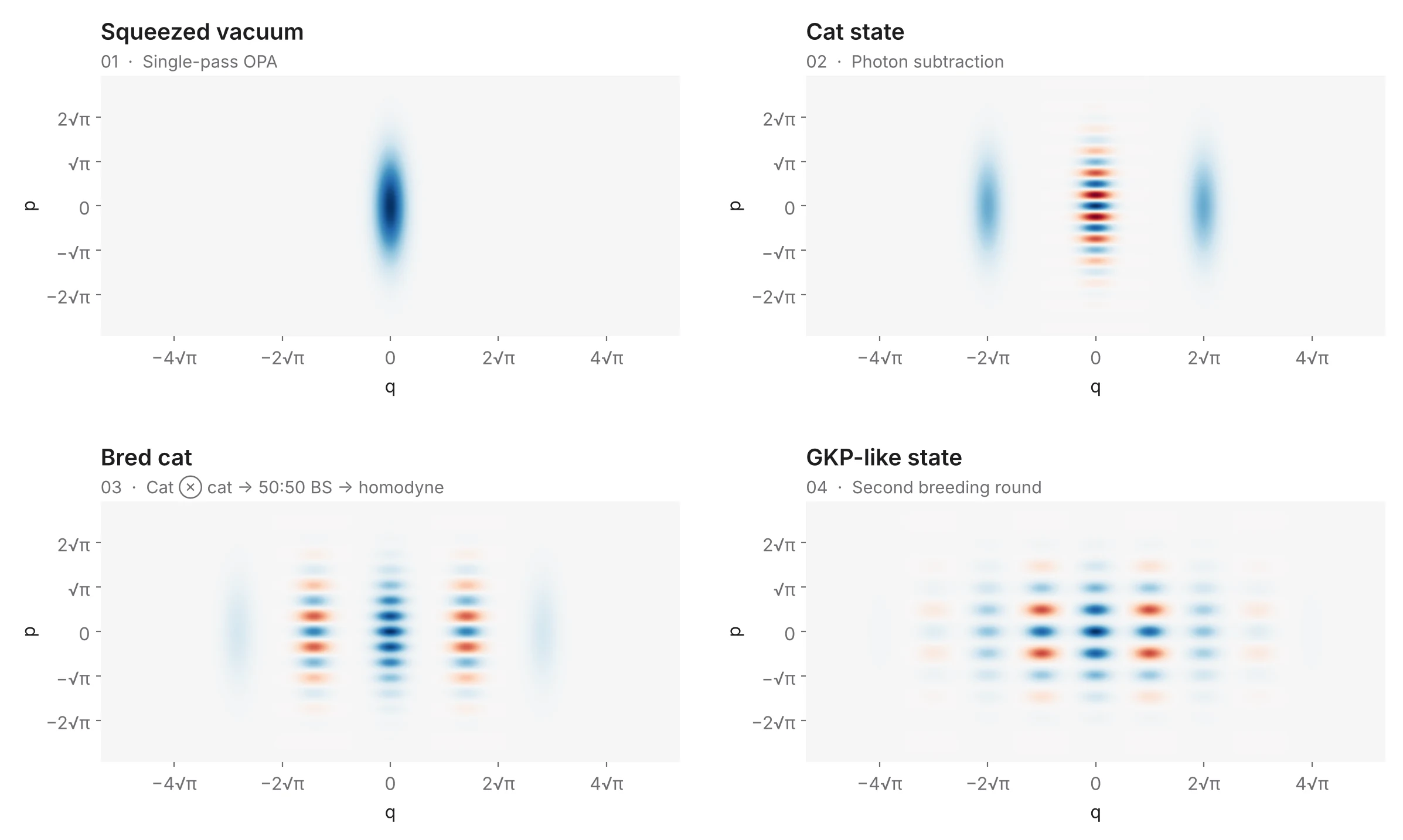
Four Wigner functions: squeezed vacuum, cat state, bred cat with three peaks, and a GKP-like state with five peaks spaced by two root pi

01 · Phase space

From squeezed light to a GKP grid.

Wigner functions (blue positive, red negative) of a squeezed vacuum, a squeezed cat, and the outputs of one and two breeding rounds. Two rounds place five peaks exactly on the 2√π lattice with weights 1 : 4 : 6 : 4 : 1.
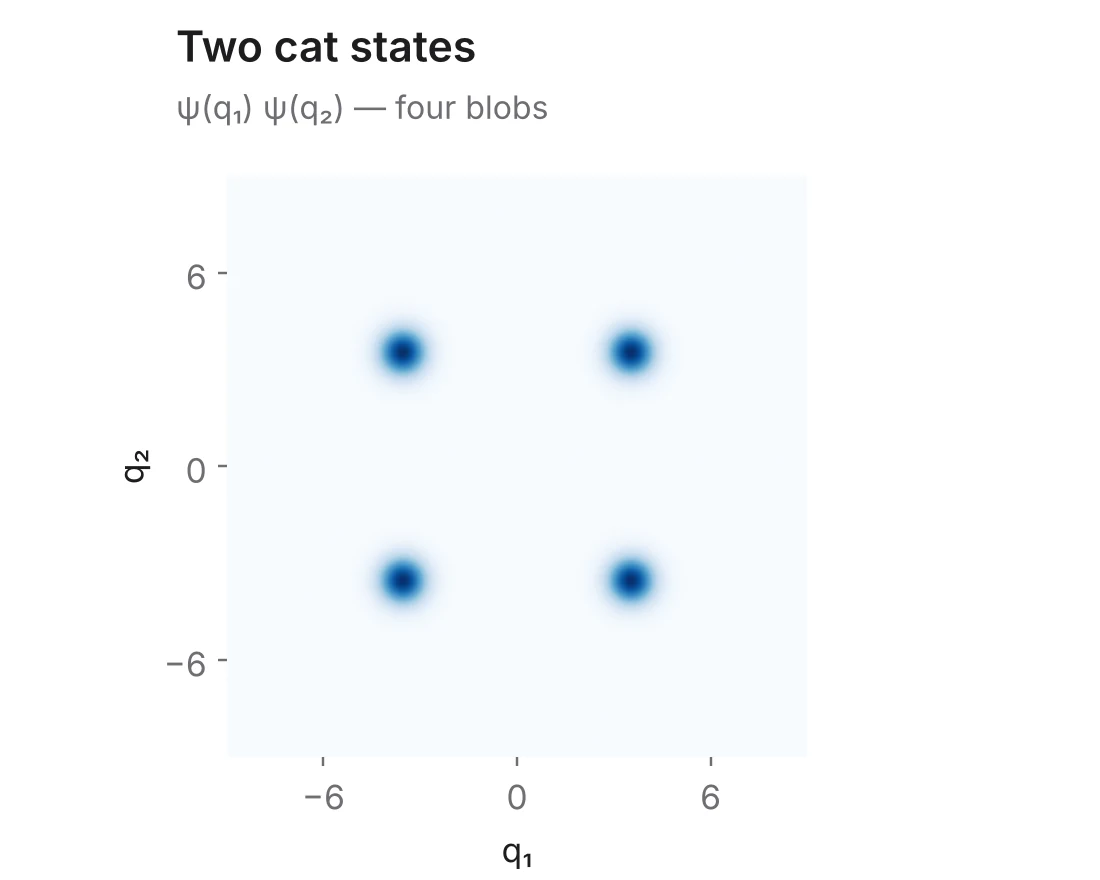
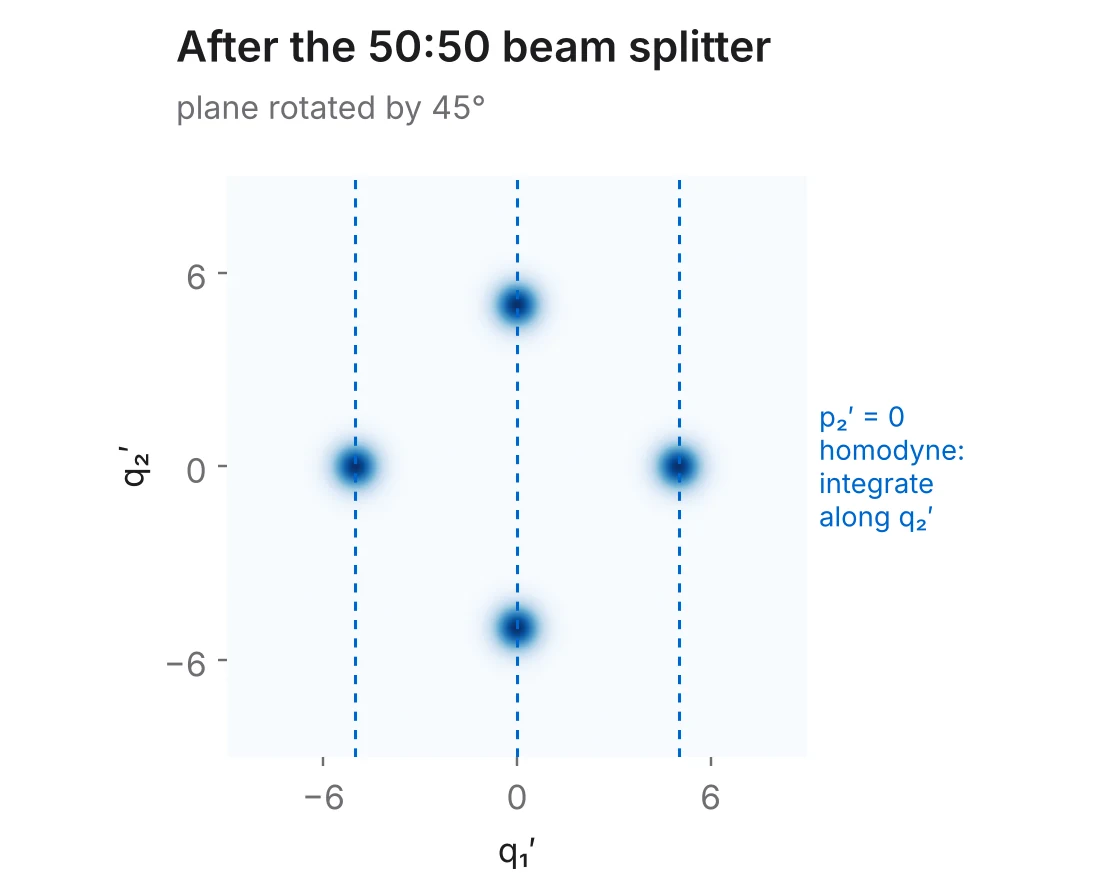
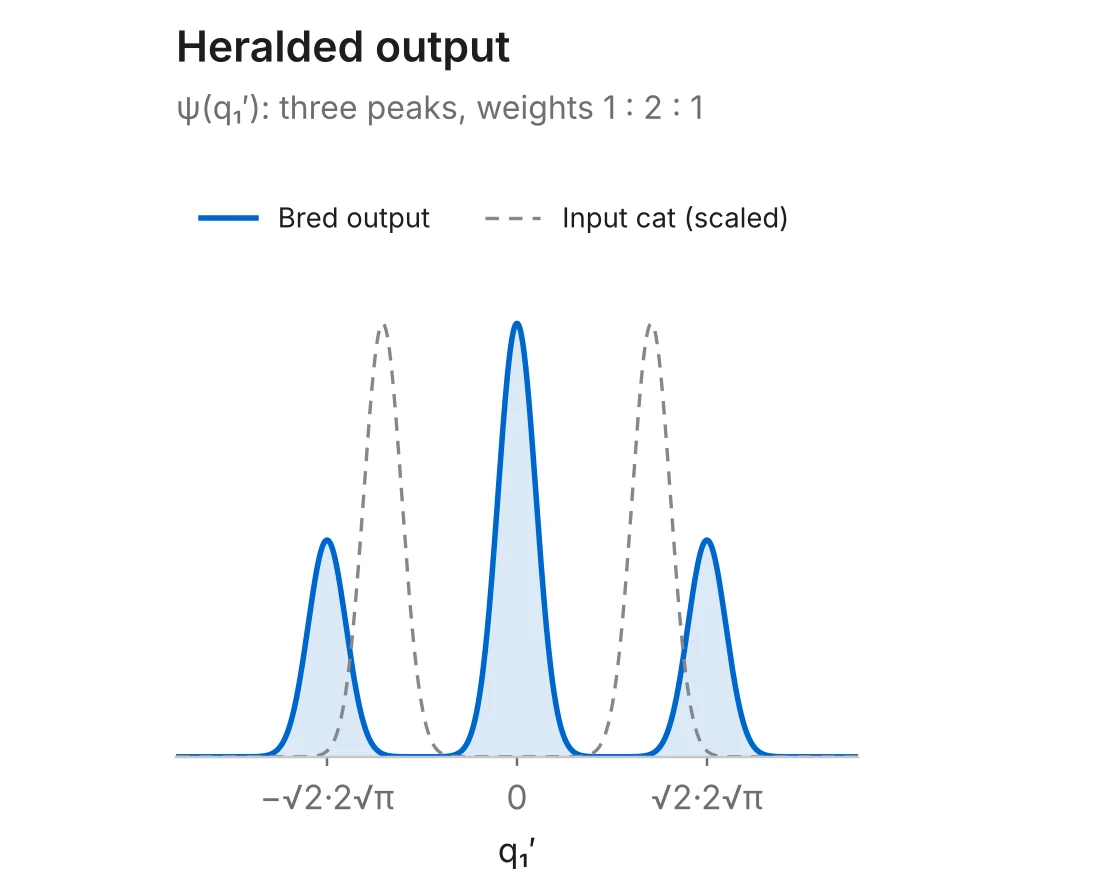
Two cat states as four blobs in the q1, q2 plane After a 50:50 beam splitter the four blobs form a diamond; homodyne integrates along q2 prime Heralded output wavefunction with three peaks of weights 1 to 2 to 1

02 · Breeding

Two cat states.

Each arm carries a cat with peaks at ±2√π in q. Together they make four blobs in the (q₁, q₂) plane.

After the 50:50 beam splitter.

The beam splitter rotates the (q₁, q₂) plane by 45°, turning the square of blobs into a diamond.

Heralded output.

Homodyne detection of the upper arm at p = 0 integrates along q₂′. The scan line crosses one, two, then one blob — the lower arm is left with three peaks, weights 1 : 2 : 1.

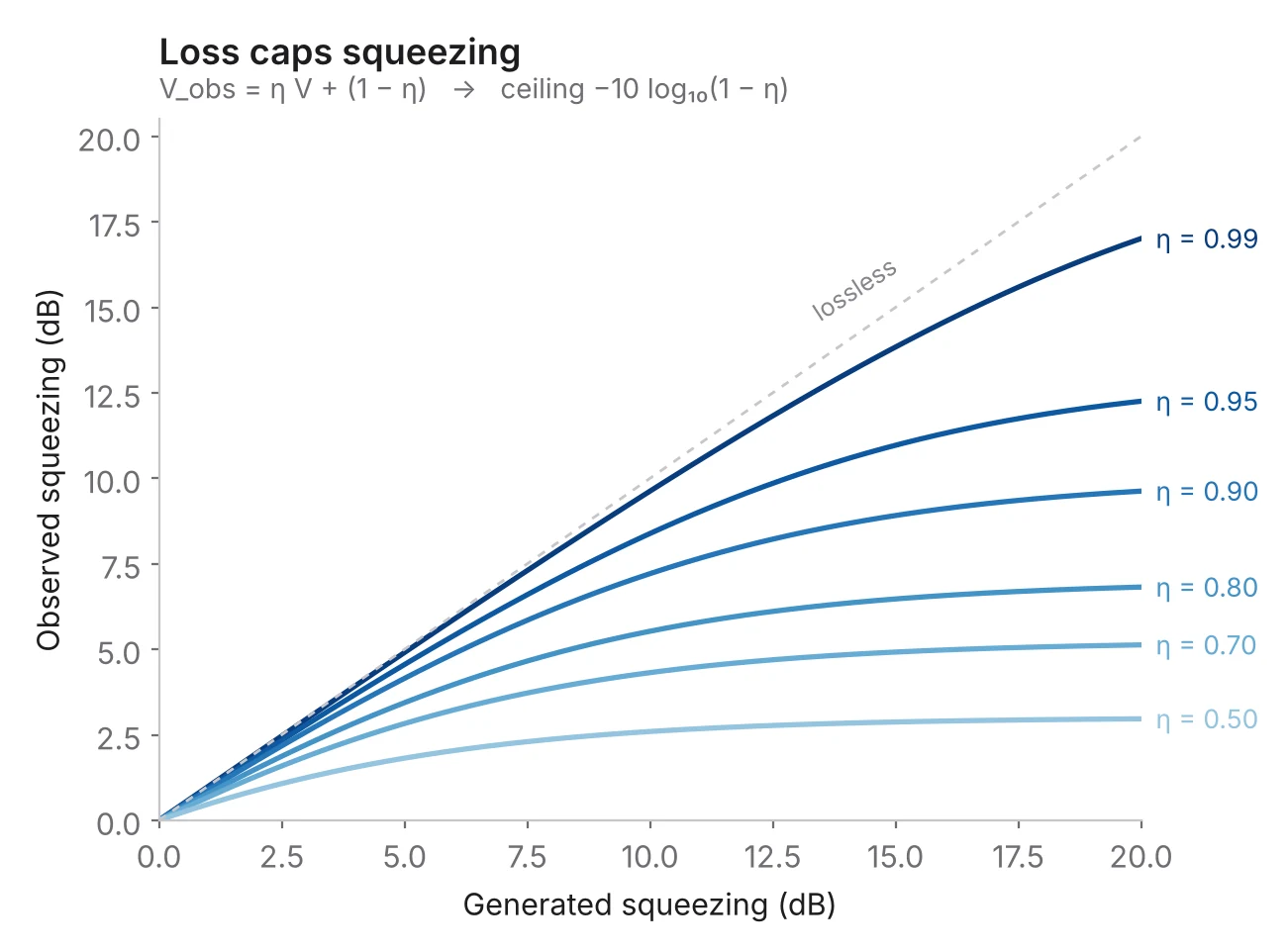
Observed squeezing versus generated squeezing for transmission from 0.5 to 0.99, each curve saturating at a loss-set ceiling

03 · Loss

Every component leaks.

Squeezer propagation, edge couplers, beam splitters and detector efficiency all multiply into one transmission η. Observed squeezing saturates at −10 log₁₀(1 − η), however strong the source.

The design question

Low loss is everything.

Past a few dB, more squeezing barely helps — transmission sets the ceiling. So I translate fault-tolerance thresholds into a loss budget for each component on our LTOI chip.

Vobs = η V + (1 − η)

Research Interests

Loss is the bottleneck.
I want to engineer around it.

Optical loss limits both discrete- and continuous-variable photonic architectures. My work connects what a fault-tolerant state needs in theory to what each on-chip component must actually deliver.

01

CV photonic quantum computing

Squeezed light, cluster states and measurement-based computation on integrated photonic hardware.

SqueezingCluster statesMBQC

02

GKP & bosonic codes

Generating GKP states through cat breeding, and deriving the loss, squeezing and detection each component must reach.

Cat statesBreedingWigner function

03

Photonic integrated circuits

χ(2) thin-film lithium tantalate circuits — single-pass squeezers, beam splitters and pump filters on one chip.

LTOIPPLTSingle-pass OPA

Research Experience

From hardware logic
to quantum light.

CurrentJun 2026 - Present

Research Intern

Q-SPIN Lab, Seoul National University · Prof. Donguk Nam

  • Responsible for the quantum-theory track of the lab's LTOI chip — cat generation, breeding toward GKP — and for setting the threshold each component must reach.
  • Co-own beam splitter and pump filter design for the tape-out: MMI, directional and adiabatic couplers, and 775/1550 nm pump rejection, modelled with eigenmode (FDE) simulation in Ansys Lumerical MODE.
  • Simulate photonic quantum circuits — photon-pair sources and MZI networks in Perceval, and loss-aware Gaussian-state models of GKP generation.
  • Survey CV quantum computing architectures and presented graph-designed quantum photonics (Bao et al., Nature Photonics 2023) at lab group meeting.
Lumerical MODEPercevalThe WalrusPython
UndergraduateFeb - Jun 2026

Undergraduate Researcher — 2D Semiconductors

Prof. Juwon Lee's Lab, SKKU

  • Studied 2D semiconductor devices and presented a review of MoS2-based memory — the first exposure to optoelectronics that turned my focus to quantum photonics.
UndergraduateMar - Jul 2025

Undergraduate Researcher — Digital Hardware

Prof. Tae-wook Kang's Lab, SKKU

  • Designed an 8-bit STFT compute module: profiled value distributions in Python to set the quantization scheme, then implemented it in Verilog.
VerilogPythonFixed-point quantization

Education

Where I've studied.

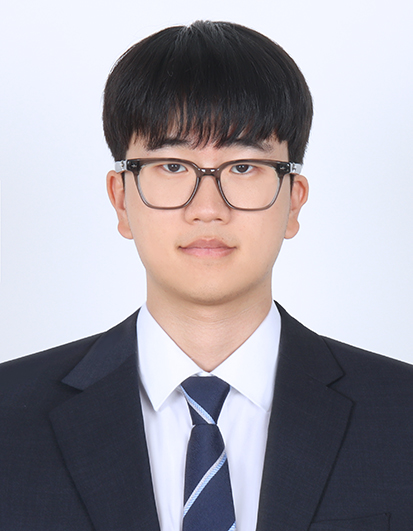
Portrait of Minsuk Jun

Minsuk Jun

전민석

2020 — Feb 2027 (expected)
B.S. Electrical & Electronic Engineering
Sungkyunkwan University, Seoul · GPA 4.20 / 4.5
Coursework: Quantum Mechanics, Electromagnetics, Optics, Linear Algebra
Aug - Dec 2025
Study Abroad
Nanyang Technological University, Singapore
Top of class in Semiconductor Devices and Processing
2022 — 2024
Military Service
Republic of Korea Air Force · Honorably discharged as Sergeant

Selected Projects

Things I've built.

Device · 2026

Photonic Circuit Design & Simulation

Beam splitters, pump filters and waveguides for an LTOI tape-out, from mode analysis to circuit-level simulation of sources and interferometer networks.

Lumerical MODEMMI · DCPerceval

Theory · 2026

Ideal Quantum Photonic Circuit Theory

The lossless picture of cat generation and breeding: how photon-subtracted cats combine on a beam splitter and homodyne into GKP grid states.

Cat statesBreedingGKP

Architecture · 2026

CVQC Architecture Research

How measurement-based CV quantum computers are assembled — non-Gaussian state sources, refinement, cluster states — and where optical loss breaks each stage.

Fault toleranceLoss budgetCluster states

Skills & Beyond

Toolbox.

Simulation & Code

  • Python (NumPy, SciPy)
  • Ansys Lumerical MODE
  • Perceval · The Walrus
  • Verilog
  • PSpice

Leadership

  • Vice President, SIOR Robotics Club (SKKU)
  • Arduino workshop instructor — education outreach
  • Organizer, campus technical seminars

Languages

  • Korean — Native
  • English
  • Japanese — JLPT N2

Contact

Let's talk photons.

Open to research collaborations and conversations about photonic quantum hardware.

tf583316@gmail.com